Date: 26/12/2019
Happy holidays to all readers! I am Victoria, the third observer on board Hurtigruten Midnatsol, together with Popi and Lucía. I am a master student at The Arctic University of Norway, doing my master project as part of this larger collaborative project on distribution of krill-predators in the Southern Ocean. I will analyse and write about the data collected on seabirds in the Scotia Sea this season.
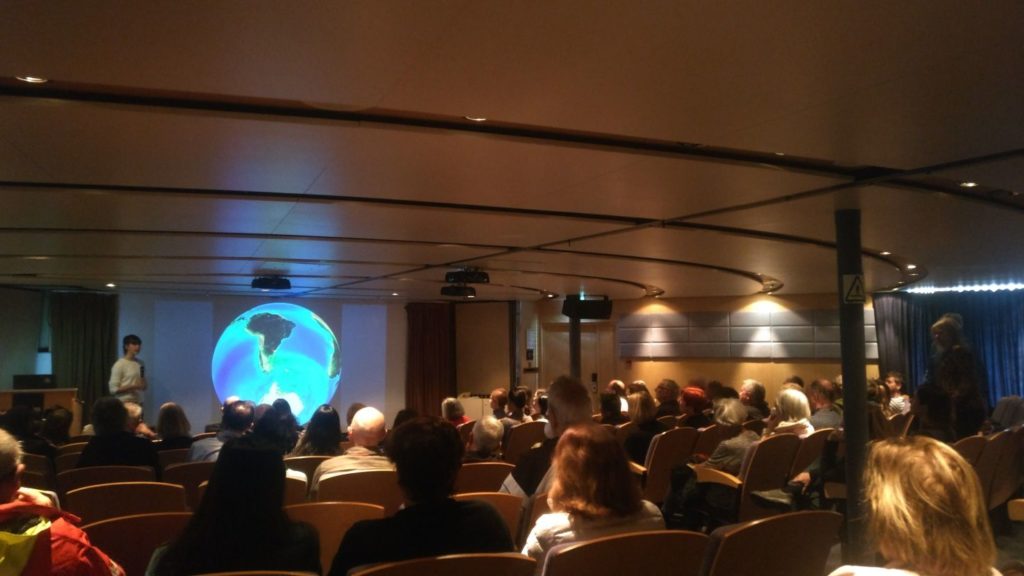
It has been an amazing experience, we have gathered a good amount of data, and I feel like I have learnt so much! Now we are celebrating a different Christmas than we are used to, with penguins and light all night long. I was asked to write a summary of a talk I gave here on board the ship, on whales, seals and seabirds as krill-dependent predators in the Southern Ocean. So here we go.
The Southern Ocean ecosystem is affected by strong seasonal variations in temperature, ice, and light conditions. Winters are cold and dark, and the sea ice doubles the size of the continent. On the contrary, in summers the sea ice retreats, and the almost 24 hour long days make it possible for the phytoplankton to photosynthesize day and night. The amount of light, in combination with the nutrients brought up from the deep sea by upwelling at oceanic fronts and coasts, create excellent conditions for the phytoplankton and the high production of the system attract a variety of predators from more northern latitudes to exploit the food resources in the Southern Ocean.
Antarctic krill (Euphausia superba) is a key species in the Southern Ocean ecosystem, since a majority of species depend on it directly or indirectly. In a simplified Southern Ocean food web, we have phytoplankton as the producers of the system, krill as a primary consumer, directly krill-dependent predators like baleen whales, many seabirds and some seals, and indirectly krill-dependent predators like orcas, leopard seals and skuas, that feed on krill-predators.
Another krill-predator is us humans, and our catches of krill in the Scotia Sea have doubled in the last decade. Still we catch only around half of the precautious catch limit, set at 600 000 tons, so why worry? First, it is not important only how much we catch, but also where we catch krill. If we take out significant amounts of krill in the feeding areas of krill predators, this will most likely have a negative impact on the populations. This is why we are interested in where and when the krill is consumed by these predators. In other words, we are interested in the spatial and temporal distribution of marine mammals and seabirds. Second, since marine mammals were protected from hunting, the heavily reduced populations have shown a slow recovery towards natural population sizes. Though the population sizes of many species are still far smaller than they used to be, this slow increase also means an increasing need for food. This increasing need for prey by krill predators needs to be accounted for by the fisheries. Lastly, climate change is predicted to reduce krill stocks due to changes in the phytoplankton community caused by decreased sea ice extent, thickness and duration, freshening of sea water and ocean acidification. Also, Antarctic krill is a cold-water species, with a physiology adapted to low temperatures, so warmer temperatures will reduce its fitness and thereby likely the stock.
Thereby, the worry is increased krill fisheries in a warming climate. We need to ensure that there is enough food for krill dependent predators when and where they feed. To do this we need distributional data on these animals, that will be used by CCAMLR (Commission for the Conservation of the Antarctic Marine Living Resources) to set time and site specific quotas for the krill fisheries. The distribution of marine mammals and seabirds can be studied by both tags and observations. These two methods complement each other, since they give us different information. With tags we can get very detailed information about a few animals; where they feed and breed, how fast they travel, and so on. With observations we can study the amount of animals and make population estimations. We study the distribution of krill predators, marine mammals and seabirds, by making observations on board Hurtigruten Midnatsol and Fram. We count all animals observed in a predetermined area. Only a sample of the animals in the area will be detected however, and the probability of detecting an animal decreases with distance. When the total amount of animals in the whole study area is later estimated, these factors will be accounted for by the application of detection functions.
So lastly, and most interestingly, what have we seen so far on board Hurtigruten Midnatsol? Humpback whales are by far the most common sighting here in the icy fjords and bays, but we have also spotted quite a few orcas and minke whales, fin and sei whales, and a blue whale and two groups of hourglass dolphins in the Drake Passage. On land we have seen southern elephant seals, and crabeater and weddell seals have been spotted both on land and resting on ice bergs. Of the seabirds, we have seen all in the area frequently residing species; gentoo, chinstrap and adélie penguins, wandering, royal, black-browed, light-mantled sooty and grey-headed albatrosses, giant, cape, antarctic, storm, blue, snow, diving and white chinned petrels, southern fulmar, sooty shearwater, Wilson´s and black-bellied prions, antarctic shag, kelp gull, antarcic terns, and skuas. Now we are eager to see what we will see on our final crossing of the Drake Passage, so stay tuned!
Wishing you a very happy new year!
Victoria (26.12.2019)