
How much krill do whales eat? And why do we need to know this?
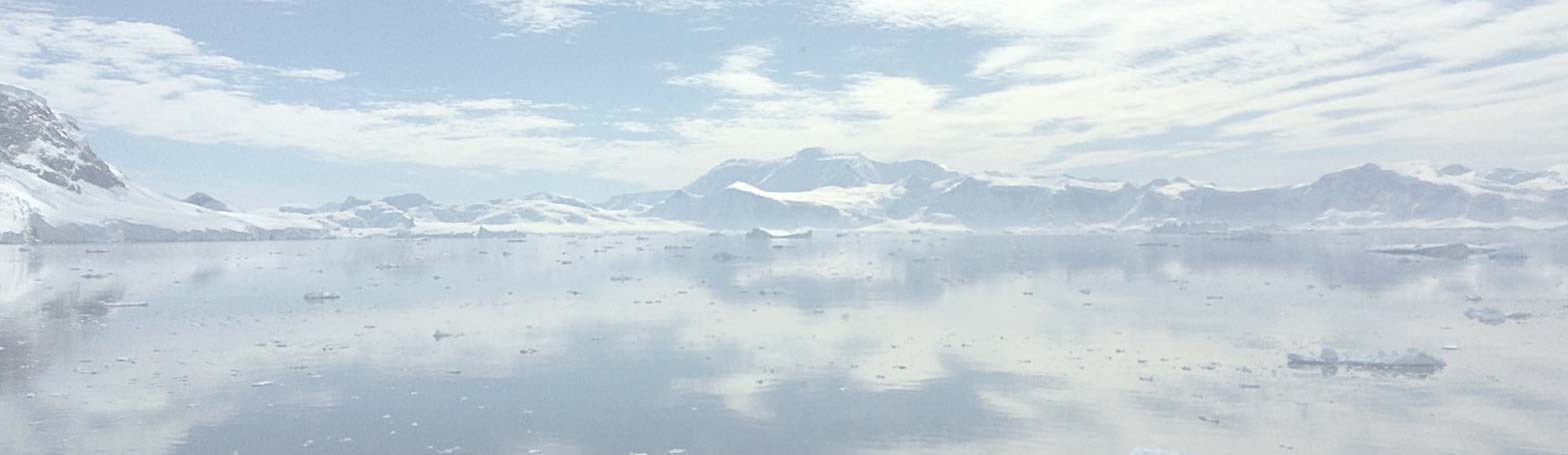
Wilhelmina Bay
26/12/2019
Stock assessment models are used to assess the amount of fish that we, humans, could withdraw from the ocean without harming the sustainability of the fishery and the ecosystem that depend on it. In short, stock assessment models contrast the reproductive capacity of the fishery against its mortality rate, that is composed by three main factors: natural mortality, predators and fishing activity. Therefore, in order to set a safe krill catch limit (a.k.a. quota), we need to know how much krill there is, how many predators feed on them and how much krill these predators eat.
On these days in the Southern Ocean, humpback whales were the most seen cetacean species. In fact, here at Wilhelmina bay humpback whales offered us an amazing spectacle in which groups of 4 to 6 humpback whales were constantly lunge feeding at the surface. Wherever you were looking, blows and expanded grooves were seen. If in silence, you could also hear their blows and inhalations, their open mouth breaking the surface to engulf tons of water… What an amazing moment!!! That is what they told me, and I truly believe them, as I had to be on the main ship taking care of my recent knee injury. At least I could see them far away and let my imagination free to experience it… in a different way!

Humpback whales belong to the rorquals family, which also include fin and blue whales, also present in the Southern Ocean, and are characterized for being lunge feeders that separate the prey from engulfed water using plates of keratin that hang down from the top of their mouths. Here, in the Southern Ocean, krill is their main prey. Rorquals migrate to rich feeding areas close to the poles in summer, and return to warmer seas, towards the equator, in winter for mating and breeding. In order to survive the fasting period at the mating areas, they need to feed as effectively as they can during the summer to build up a thick layer of blubbery reserves to fuel it through the harsh food-starved winter. And these is extremely important for pregnant females that will have to feed their calves, while fasting.
Digital tags attached to the whales’ back when they surface, have revealed information about the way lunges are performed, the amount of energy expended and the amount of energy gain in a lunge. The data-loggers record the whales’ depth, their underwater orientation, their acceleration, and the noise of the surrounding water. The sound of water rushing past the animal is used to infer how fast the whales are travelling.

During a lunge, the whale oscillates its tail and fluke to accelerate the body to high speed, up to 3 meters per second, and opens its mouth to about 90 degrees. Rorquals have a tongue that can invert retreating through the floor of the mouth and back towards the belly button, forming a capacious oral sac that accommodates the engulfed seawater on the ventral side of the body. The drag that is generated allows the water to enter its oral cavity, which has pleats that expand up to four times their resting size. Whales engulf a volume of water that is greater than its own body mass, which represents a major source of energy expenditure during a lunge. After the whale’s jaws close, the full size of the engulfed water mass is evident as the body takes on a “bloated tadpole” shape. In less than a minute, all of the engulfed water is filtered out of the distended throat pouch as it slowly deflates, keeping the prey inside the mouth.
The tag data have shown that rorquals feed both at the surface and at depth. In some cases, whales perform dives of 3 to 15 minutes up to 300 m where they perform up to 6 lunges within a dive. This lunging behaviour at depth has been confirmed with the usage of a video camera with infrared light, attached to the back of the whale, which shows the whale swimming through dense fields of krill at the bottom of deep dives. Foraging dives that involve more lunges at depth result in more surface recovery time after each dive. Because maximum dive time is limited by these high foraging costs, rorquals are particularly dependent on dense aggregations of prey, which tend to be very deep.
In the Antarctic, summer schools of krill can be several km in diameter, with as many as 30,000 animals per cubic meter. Blue whales, the largest animal on Earth, can hold 90 metric tons of water and prey in a single lunge, allowing the whale to consume an estimated 3.6 metric tons of krill or 40 million individuals every day. This corresponds to an ingestion of about 750,000 calories in a single lunge, which is about 240 times as much energy as they burn in that lunge. This leads to estimate a mass gain of 90 pounds per day. Thus, leading to blue whales being super-efficient when lunge feeding on high dense krill patches. Fin whales by being smaller, can engulf 70 metric tons of water and prey in a single lunge, a volume heavier than its own weight. To date, there are no estimates for humpback whale krill consumption per day. But scientific research is being conducted to get those estimates.

All of these studies will contribute to the future management of Antarctic krill fisheries with the aim to preserve the natural equilibrium of the predator-prey dynamics in the Southern Ocean ecosystem.
Written by Lucía, 26th December 2019